


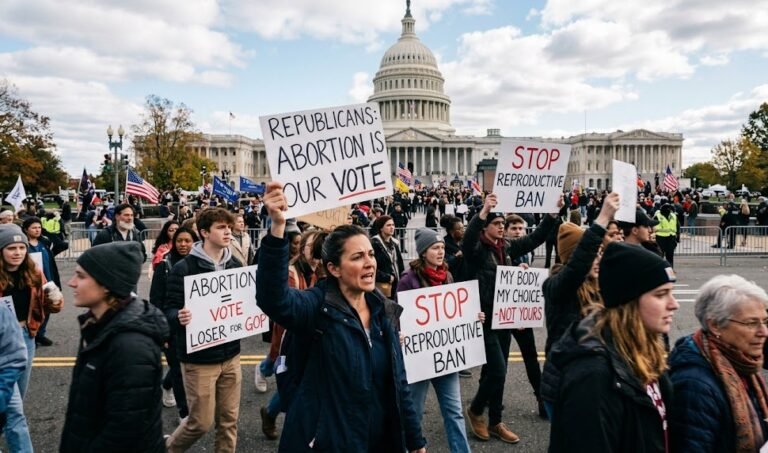
WASHINGTON, D.C. — For decades, opposition to abortion served as a rallying point for conservatives and a cornerstone of Republican political campaigns. However, recent election cycles suggest that the issue has evolved into a significant political challenge, with some analysts describing it as an “Achilles heel” for the Republican Party.
The shift became increasingly apparent following the landmark decision by the U.S. Supreme Court in the Dobbs v. Jackson Women’s Health Organization Decision, which overturned the constitutional right to abortion established under Roe v. Wade. While many conservatives celebrated the ruling as a major victory, its political consequences have proven far more complex.
Instead of ending the national debate, the decision transferred authority over abortion laws to individual states, transforming the issue into a powerful electoral force that continues to influence campaigns across the United States.
A New Political Reality for Republicans
Political strategists note that abortion has become a uniquely challenging issue because it motivates voters on both sides of the debate. While conservative voters remain strongly engaged, abortion rights supporters have also become increasingly active in local, state, and national elections.
In several recent elections, candidates aligned with strict abortion restrictions have struggled to gain support from independent voters and moderate suburban communities. Democratic candidates, meanwhile, have frequently highlighted abortion access as a central campaign issue, particularly among women and younger voters.
As a result, Republicans are facing a difficult balancing act between satisfying their conservative base and appealing to a broader electorate.
Why the Issue Has Become an Electoral Vulnerability
Analysts point to several factors contributing to the Republican Party’s challenges on abortion.
First, public opinion remains nuanced. Many Americans support some restrictions on abortion while also favoring exceptions in cases involving rape, incest, or risks to a mother’s health.
Second, state-level abortion bans have brought real-world policy impacts into sharper focus. Voters are increasingly evaluating how laws affect healthcare providers, patients, and families rather than viewing abortion solely through an ideological lens.
Third, abortion-related ballot initiatives have repeatedly demonstrated strong voter engagement, including in states traditionally viewed as politically conservative.
These developments have made it more difficult for Republican candidates to rely on uniform messaging across different states and regions.
| Political Factor | Electoral Impact |
|---|---|
| State abortion bans | Increased voter scrutiny of Republican policies |
| Women’s voting patterns | Stronger mobilization around reproductive rights |
| Ballot initiatives | Higher turnout among abortion-rights supporters |
| Internal party divisions | Inconsistent campaign messaging |
| Swing voter concerns | Greater pressure on moderate Republicans |
Women Voters Are Reshaping the Debate
One of the most significant developments has been the growing influence of women voters in elections where abortion rights are a major issue.
Political observers note that suburban women, in particular, have become a key voting bloc. In several battleground races, concerns about reproductive rights have influenced campaign discussions and voter priorities.
Democratic candidates have frequently argued that abortion restrictions threaten personal freedoms, while Republicans have attempted to shift the conversation toward family support policies, parental rights, and limits on late-term abortion procedures.
The effectiveness of these competing messages continues to vary depending on local demographics and political conditions.
Beyond Politics: A Broader National Debate
The abortion debate extends far beyond election campaigns. The issue increasingly intersects with healthcare policy, business decisions, legal frameworks, and economic considerations.
Several employers have adjusted healthcare benefits to accommodate workers living in states with differing abortion laws. Medical associations have also raised concerns about legal uncertainty surrounding emergency reproductive care and physician responsibilities.
As a result, abortion is no longer viewed solely as a social issue. It has become a policy debate involving healthcare systems, labor markets, state governments, and corporate America.
Republicans Face a Long-Term Strategic Question
Looking ahead, Republican leaders face a significant strategic challenge. The party must determine how to maintain support among anti-abortion voters while limiting potential electoral losses among independents and moderates.
Some Republican candidates have advocated for restrictions after a specified number of weeks rather than supporting complete bans. Others continue to endorse stricter measures, arguing that their voters expect a firm stance on the issue.
This divide highlights a broader tension within the party as leaders seek a message capable of succeeding in both primary elections and highly competitive general elections.
Additional Analysis: Why the Issue Continues to Matter
Political experts believe abortion will remain one of the defining issues in American politics for years to come. Unlike many campaign topics that fade after elections, abortion directly affects legislation, court decisions, healthcare systems, and public policy debates.
The issue also has a unique ability to drive voter turnout. Research consistently shows that voters who prioritize abortion rights or restrictions are often highly motivated to participate in elections, making it one of the most influential issues in modern American politics.
Looking Ahead
As future elections approach, abortion is expected to remain a central battleground for both major political parties.
For Democrats, the issue provides a powerful organizing tool capable of mobilizing key voter groups. For Republicans, it represents a continuing challenge that requires balancing ideological commitments with electoral realities.
Whether the party can successfully navigate that challenge may play a critical role in determining its political fortunes in upcoming election cycles.
