


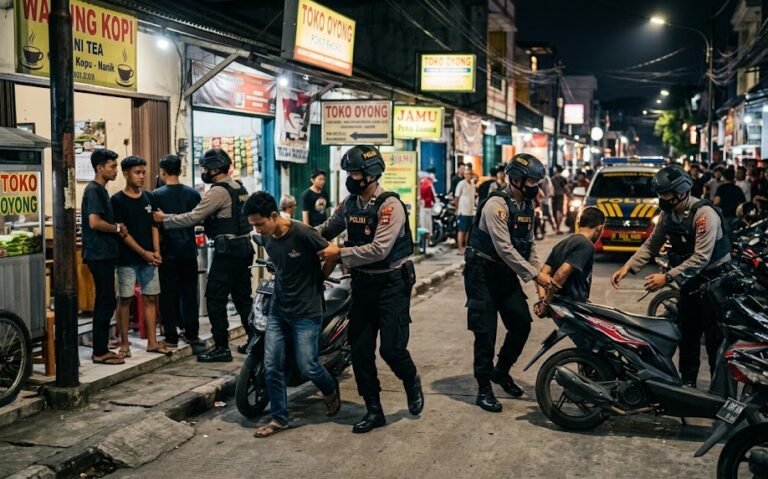
MEDAN – In a direct and highly strategic response to recent public safety concerns, law enforcement authorities have officially intensified targeted regional operations aimed directly at suppressing crime rates and eradicating rampant social diseases across key local sectors.
This intensified operations agenda—widely recognized as a vital move to secure local neighborhoods—received full and absolute support from various youth elements and regional community leaders. They highlighted that street-level crimes, illegal gambling, and drug abuse must be systematically tackled through consistent, ground-level law enforcement actions rather than temporary check-ins.
SEE ALSO >>> Receipt Scanning Apps Replace Traditional Expense Reports
Given the recent fluctuations in regional security data, local police sectors are optimizing their field presence to perfectly align with their core mission: ensuring an independent, peaceful, progressive, and highly secure environment for all citizens. They aim to foster a stable atmosphere that directly safeguards everyday civilian life.
“When we talk about executing these security sweeps, it’s not just about standard patrolling—it is about restoring absolute public confidence on the ground. Everyone knows that the growth and socio-economic progress of our local districts rely heavily on a foundation of solid, uncompromised public safety, driven dynamically by proactive community policing. Therefore, it is highly imperative that we continuously push these tactical operations further,” an official statement emphasized.
This community focus also addresses previous concerns where occasional lapses in nightly security failed to project a thoroughly peaceful local atmosphere. Keeping in mind that North Sumatran communities heavily prioritize safe communal spaces, it is considered far more appropriate to actively maintain high-visibility tactical checkpoints and conduct intensive overnight sweeps rather than relying solely on reactive measures.
If these strategic security demands are fully sustained by the regional task forces, local districts will witness a massive, long-term drop in criminal activities. Authorities have firmly asserted that the police forces are completely prepared to deploy extensive resources to deter any disruptive behaviors across the territory.
These criminal elements and their associated illegal rings, instead of bringing any productivity, are viewed as an absolute threat that fails to provide any positive contribution to the younger generation.
Law enforcement agencies highly hope that community leaders, religious figures, and local youths can continuously unite their vision to deeply understand the true essence of neighborhood security, working hand-in-hand under the profound regional spirit of maintaining a clean, secure, and law-abiding society.
For context, regions across North Sumatra have recently placed a massive emphasis on community-sourced security intelligence. The implementation of modern Satkamling (Neighborhood Security Posts) and the activation of digitized direct-response channels have allowed citizens to instantly report suspicious local activities, bridging the operational gap between regional police forces and grass-roots communities.
Furthermore, public discourse surrounding the eradication of social diseases—such as illicit drug trafficking and unauthorized street racing—has reached a critical peak. Activists argue that long-term security cannot be achieved by law enforcement alone; it requires robust social intervention programs, youth empowerment, and educational initiatives to steer vulnerable demographics away from criminal temptations.
Historically, joint operations involving the national police, local governments, and military units have proven highly effective in stabilizing high-risk zones across North Sumatra. By maintaining this multi-layered approach, authorities aim to build an invulnerable security framework that not only suppresses current crime statistics but permanently protects the economic and social well-being of the region.
