


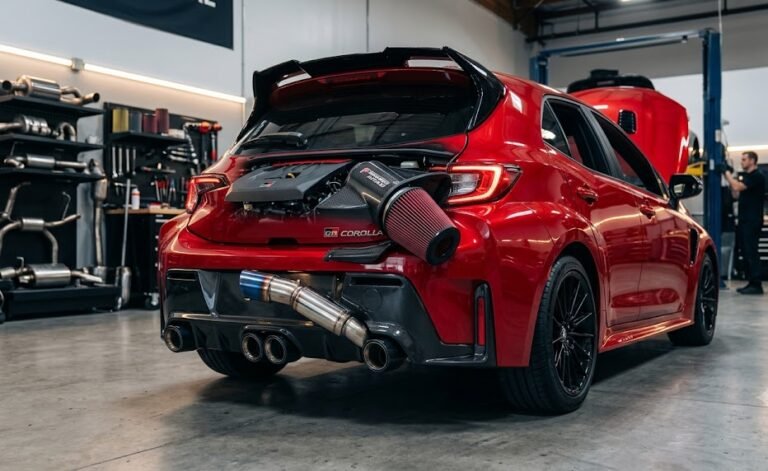
Finding the perfect synergy between forced induction intake flow and exhaust backpressure is essential to prevent engine hesitation or check-engine light errors. The following setups stand out as the most cohesive hardware combinations dominating the 2026 custom tuning scene:
1. The Track Enthusiast Setup: Eventuri Carbon Intake + Remark Quad-Tip Exhaust
For those prioritizing maximum top-end power gains and absolute build quality, combining the Eventuri carbon fiber intake system with the Remark cat-back exhaust yields excellent results.
Eventuri’s bespoke housing features a patent-pending reverse cone configuration that ensures a smooth, non-turbulent aerodynamic flow directly into the turbo.
Paired with Remark’s quad-exit configuration—which replaces the factory triple-exit layout—this combination significantly reduces backpressure while producing a sharp, aggressive rally note under load.
2. The Street-Refined Choice: MST Performance Intake + Apexi N1 Evolution Extreme Exhaust
If your 2026 build serves as a daily driver, maintaining a deep rumble without excessive cabin drone is paramount. The MST Performance intake uses a high-flow dry filter element protected by an integrated heat shield that blocks engine bay temperatures.
When paired with the Apexi N1 Evolution Extreme exhaust system, the vehicle produces a resonant, deep bass tone at low revs that transforms into an exotic wail at full throttle, fully complying with moderate sound limits while providing excellent throttle response.
3. The Pure Raw Acoustic Build: HKS Premium Suction + Tomei Expreme Ti Titanium Exhaust
For purists who want to hear every mechanical nuance, combining the HKS Premium Suction intake kit with the ultra-lightweight Tomei Expreme Ti titanium exhaust is the go-to choice. HKS maintains structural airflow optimization utilizing open-filter characteristics to magnify the turbo spooling sound.
Meanwhile, the Tomei titanium exhaust strips away significant weight from the chassis while delivering an uncompromising, raw racing exhaust note that turns the three-cylinder engine into a fierce acoustic display.
Calibration Challenges and Electronic Control Unit Limits
Tuning the 2026 model year of the GR Corolla requires a deep understanding of its advanced engine management system. Toyota’s modern Electronic Control Unit (ECU) relies heavily on mass airflow (MAF) sensors and manifold absolute pressure calculations to regulate air-fuel ratios. Installing an unverified intake system with an incorrectly sized intake pipe diameter can distort sensor readings, leading to a lean air-fuel mixture or triggering emergency engine safe-modes.
Furthermore, upgrading the exhaust system on the latest hot hatch platforms requires a strategic approach to the catalytic converter system. While a simple cat-back or axle-back exhaust replaces the mufflers and mid-pipes without modifying the factory emissions equipment, replacing the downpipe changes exhaust velocity radically. Car tuners highlight that the G16E-GTS engine reacts quickly to changes in exhaust scavenging velocity, making high-quality, flow-optimized downpipes crucial if you intend to tune the vehicle down the line.
Ultimately, proper component pairing ensures that these systems operate in harmony without requiring an immediate, expensive custom ECU remap. Keeping the air intake heat-shielded and choosing an exhaust system equipped with functional exhaust valves allows owners to retain the versatile driving nature of the GR Corolla—keeping it quiet during early morning commutes while unleashing full performance on weekend mountain runs.
